
Tag Archives: forgiveness

Episode 8: The Power of the Forgiving Heart

Welcome back to Living Life’s Way, where we share moments of profound truth and encourage your journey with “The Healing Heart Time of Prayer.” This podcast is designed for every Christian woman who longs for a deeper, more meaningful spiritual walk with God and seeks healing for her heart.
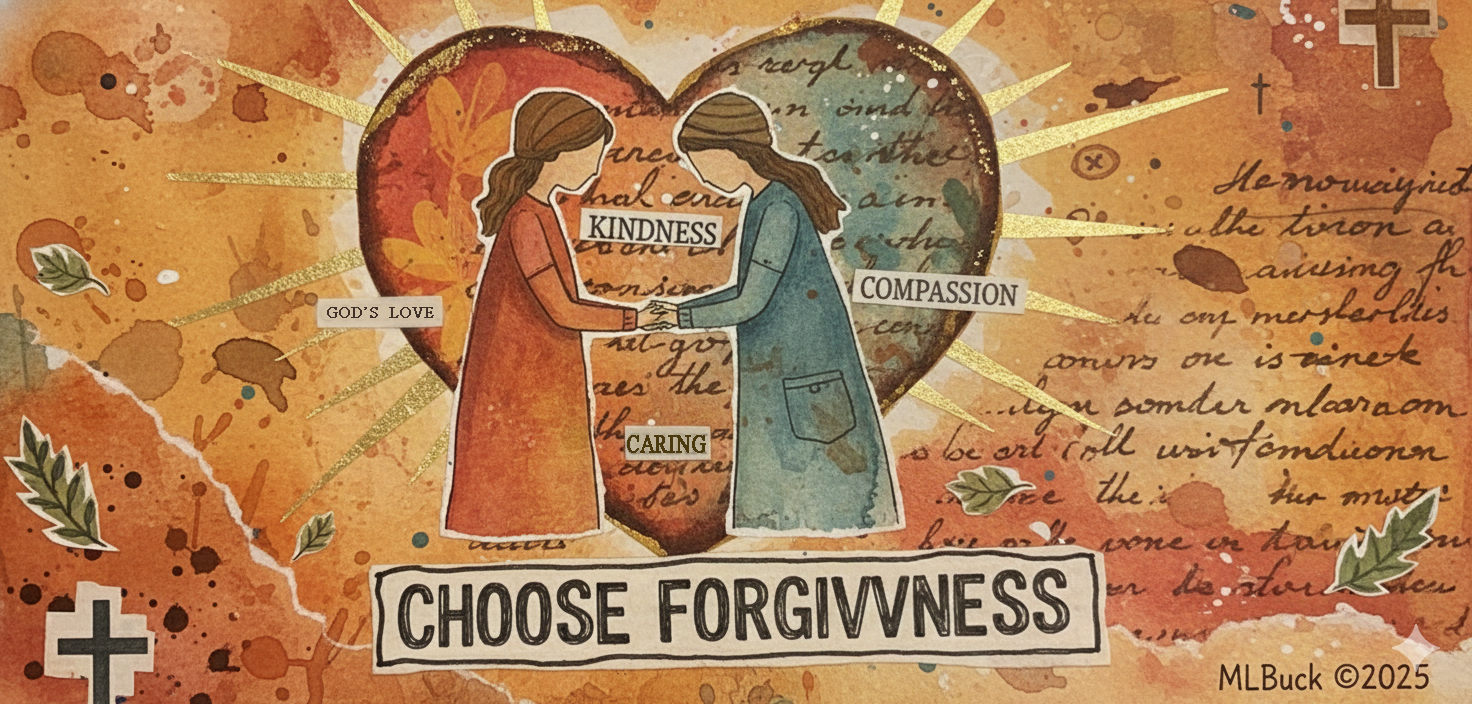
In this episode, we turn our attention to the powerful and compassionate words of Ephesians 4:32: “Be kind and compassionate to one another, forgiving each other, just as in Christ God forgave you.” This verse is one of the most direct commands for kindness and forgiveness in the New Testament.

Join Dr. Mary Buck as she explores the foundational truth that our capacity to give grace is born out of the grace we have received. This episode will guide you in understanding how our kindness to others is a direct overflow of God’s forgiveness in our own lives. It’s a liberating truth that brings healing to the heart by freeing us from the heavy burden of unforgiveness and bitterness.

We hope this podcast is more than just a listening experience; we hope it is an invitation to encounter Jesus in a new and personal way. After listening, we encourage you to use the prayer journal prompts and activity at the end of the transcript. These questions are a perfect way to reflect on the forgiveness God has given you and the peace that comes from extending that same grace to others.


THIS IS FOR INFORMATIONAL PURPOSES ONLY.

FOR MEDICAL ADVICE OR DIAGNOSIS, CONSULT A PROFESSIONAL.


The Healing Heart of Prayer: The Power of Forgiveness

Dr. Buck: Welcome back to The Healing Heart Time of Prayer. I’m Dr. Mary Buck your Christian life coach, And, I’m so glad you’ve joined me today. In our journey, we’ve talked about doing good and perseverance. Today, we’re going to dive into the core of how we do that—by embodying the forgiveness and kindness God has shown us.

Our focus today is a verse that beautifully illustrates this truth: Ephesians 4, verse 32: “Be kind and compassionate to one another, forgiving each other, just as in Christ God forgave you.”

To help me unpack this incredible truth, I have Abby, my digital assistant, with us. Abby?

Abby: Hello, Dr. Buck. That verse links kindness and forgiveness directly to God’s. What does it mean that your listener’s compassion is a direct response to the forgiveness they received when they accepted Jesus Christ as their Lord and Savior?

Dr. Buck: That’s a foundational truth, Abby. The word “just as” is a key phrase. Our kindness and compassion for others are not simply a moral duty; they are a direct overflow of the grace that has been poured into our lives. We can’t give away what we haven’t received. The more we understand the depth of our own forgiveness in Christ, the more our hearts are softened and able to extend that same grace to others.

Abby: That’s a powerful connection. But sometimes, forgiving someone who has inflicted a deep hurt feels impossible. Dr. Buck, how does this act of forgiveness bring healing to your listener’s hearts, even when it’s so difficult?

Dr. Buck: That’s where the healing comes in, Abby. Forgiveness is a deliberate choice, not a feeling. When we choose to forgive, we are not condoning the other person’s actions. Instead, we are releasing the bitterness and resentment that are poisoning our own hearts. Unforgiveness holds us captive to our past hurts and to the person who caused them. By choosing to forgive, we are not just giving a gift to someone else; we are giving a gift of freedom to ourselves. It is an act of spiritual self-care that mirrors the very heart of God.

Abby: That’s a powerful and liberating truth. Thank you, Dr. Buck. And just to let you know, our time for this episode is coming to a close.

Dr. Buck: You’re welcome, Abby. As our time together is closing, my sisters, Let’s take these truths to prayer.

Heavenly Father, we thank you for the immense grace you have shown us in forgiving our sins. We confess that we often hold grudges and struggle to let go of our own hurts. We pray that you would help us to remember the vastness of your forgiveness toward us, so that our hearts may be softened to extend that same grace to others.

Fill us with your Holy Spirit, so that we may be kind and compassionate to one another. Heal us from the bitterness of unforgiveness, and give us the courage to choose to release others, knowing that in doing so, we are truly freeing our own hearts. We pray all of this in the mighty and precious name of Jesus. Amen.

Dr. Buck: My sisters in Christ, I pray that you’ll be encouraged by the truth of God’s word. And, my friend, as you are listening today, if you have not invited Jesus Christ into your heart, do so now. Let Him heal your heart of any struggles or bitterness so that you can walk in the freedom that only God can give.

Thank you for joining me for The Healing Heart Time of Prayer. Until next time, may His peace and powerful holy presence be with you. And remember, as God gets bigger in your life, you get stronger.

Journal Prompts and Activity

Journal Prompts: The Forgiven Heart

  • Receiving Grace: Reflect on a time in your life when you experienced God’s forgiveness in a very personal and powerful way. How did that experience change you, and how does it empower you to show kindness to others?
  • Choosing to Forgive: Is there a person in your life you are struggling to forgive? Write a prayer of release, asking God to help you let go of your resentment, not for their sake, but for the sake of your own healing.
  • The Forgiveness Link: The verse connects kindness, compassion, and forgiveness. How are these three qualities intertwined in your own life? How can focusing on one help strengthen the others?

Related Activity

Today, choose one person you’ve been holding a grudge against. It could be for a major offense or a minor irritation. Instead of dwelling on the hurt, intentionally choose to pray for that person. Ask God to bless them and heal your heart. This simple act is a powerful step toward releasing the burden of unforgiveness.

Leave a comment

Filed under Change and Transformatiom

Oh, LORD! My Dinner Disappeared (And So Did My Patience)

You know those moments when you turn your back for just a second, and suddenly, chaos (or a missing dinner) ensues? That was my reality recently. I’d set down my dinner, turned to grab something, and in a flash, my new canine companion, Abby, had made herself very, very comfortable with my meal. My delicious, hard-earned dinner, gone in less than sixty seconds!

Now, rationally, I know Abby’s thinking is different than mine. She saw food, she ate it. Simple dog logic. But in that moment? Oh, LORD! My immediate reaction wasn’t sweet understanding. It was a wave of frustration, annoyance, and honestly, a tiny, stubborn grudge. And that’s when it hit me: how easily these small, everyday incidents can expose something deeper within us – like how long we can hold onto something we’d rather let go of.

The Weight of Our “Stolen Dinners”

It might just be a stolen dinner, but think about how often we hold onto bigger “stolen” moments in our lives:

 * A harsh word someone said.

 * A perceived slight from a friend.

 * A disappointment that didn’t go our way.

 * A mistake we made that we just can’t seem to forgive ourselves for.

Like a cold plate of leftovers, these grudges and resentments can linger, stealing our peace and weighing us down. We tell ourselves we’ve moved on, but then a little memory, like the thought of a lost dinner, sparks that old annoyance all over again.

What Does God Say About Letting Go?

The good news is, God doesn’t want us carrying around that kind of heavy baggage. His Word offers us freedom from the “grudges” that dim our light:

 * Forgiveness as a Command (and a Gift!): Jesus tells us repeatedly to forgive. It’s not just a suggestion, it’s a pathway to our own freedom. “For if you forgive others their trespasses, your heavenly Father will also forgive you” (Matthew 6:14). This applies to the big hurts and the small ones, even the ones caused by our furry friends! Forgiveness isn’t about excusing the behavior; it’s about releasing ourselves from its grip.

 * Letting Go of Bitterness: The Bible is very clear about the danger of holding onto anger and resentment. “Get rid of all bitterness, rage and anger, brawling and slander, along with every form of malice. Be kind and compassionate to one another, forgiving each other, just as in Christ God forgave you” (Ephesians 4:31-32). Bitterness is like a root that can poison our hearts, affecting every area of our lives.

 * The Power of Love: Ultimately, letting go is an act of love – for others, and for ourselves. 1 Corinthians 13:5 reminds us that love “keeps no record of wrongs.” Imagine how much lighter we would feel if we truly lived by that principle!

Turning Grudges into Grace

So, how do we shift from holding onto the “stolen dinner” moments to embracing God’s call to let go?

 * Acknowledge the Feeling (Without Dwelling): It’s okay to feel annoyed or hurt. Don’t pretend you don’t. But quickly hand that feeling over to God. “Oh, LORD, I’m frustrated about this!”

 * Choose Forgiveness (Even for our furry companions): Forgiveness is a choice, not just a feeling. It’s an act of the will. Decide to release the feelings and the incident.

 * Remember God’s Grace Towards You: Think about how much God has forgiven you. This memory of His immense grace can empower you to extend grace to others, even when your dinner is eaten!

 * Pray for Release: Ask God to help you release the grudge. Sometimes, we need His divine intervention to truly let go of what clings to us.

 * Focus on the Present and Future: Once released, intentionally shift your focus to what is good, true, and pure (Philippians 4:8). Don’t replay the “stolen dinner” tape.

My dear sisters in Christ, life is full of little “Abby moments” – unexpected annoyances, small disappointments, or even significant hurts that can tempt us to hold onto resentment. But God calls us to a lighter, freer way. Let’s practice releasing those burdens, remembering the boundless grace and forgiveness He has poured out on us. When we choose to let go, we make more room in our hearts for His peace, His joy, and His purposes.

What’s a small “stolen dinner” moment you’ve recently experienced, and how did you choose to respond?

Dr. Buck / Christian Life Coach /

As God gets bigger in our lives–we get stronger!

Leave a comment

Filed under Change and Transformatiom

My Father’s Chair

Oddly, one of my favorite childhood memories is that my father’s reading chair. It was softly padded, unlike the hard wooden desk seats at school. And it was covered in a wonderfully warm brown textured woven fabric. It had a separate footrest with wheels so that it could roll easily across the old wooden floors. I remember a time when I was called into my father’s room so that he could review my most recent report card and my progress at school.

It felt like I was entering the inner sanctum of our home, a very special place. As I knocked softly, my father motioned with his hand for me to enter and then he gently pointed to the footstool at his side. I took my seat next to him. Nodding, he reached for my report card, glanced it over slowly, and then began our conversation.

Today, as a Christian life coach, I realize that this memory serves me well as I grow in my Christian walk. It gives me the ability to imagine that, as my heavenly Father, God wants to talk with me and invites me to sit with Him on His throne.

As I share this story with my clients, I realize that many Christians do not understand the purpose or the meaning of being invited into God’s throne room. Today, we are going to explore the Biblical understanding of God’s throne and throne room, and perhaps most importantly, I’ll share with you 5 ways that you can enter His throne room and draw closer to God.

Introduction

From the Old Testament Bible, the Hebrew word for throne means a seat of honor and dignity. It also represents one’s power and authority to rule a people and a kingdom. For example, King Solomon’s throne was, according to Hebrew tradition (www.chabad.org), located in the Lebanon Forest just outside the City of Jerusalem. It was made from ivory and overlaid with the precious gold metal. His throne is described in 1 Kings 10:18-20:

18 Moreover the king made a great throne of ivory and overlaid it with the best gold.

19 The throne had six steps, and the top of the throne was round behind: and there were stays on either side on the place of the seat, and two lions stood beside the stays.

20 And twelve lions stood there on the one side and on the other upon the six steps: there was not the like made in any kingdom.

Here in the throne room, King Solomon met with his counselors, maintained the peace of his kingdom, administered matters of law and justice, and saw visiting ambassadors and dignitaries. Solomon’s throne reflected his position, power, and authority.

Purpose and Meaning

But what about God and His throne room? The Bible tells us that the throne room is where God dwells and reigns as King over all creation. It is a place of great power and majesty, where God’s glory is revealed. And, although, the Bible does not give us a specific physical location for the throne room of God, it does describe it as being in the third heaven, above the earth in the City of God.

The Bible gives us important glimpses into the throne room of God (e.g. Psalm 104:1-4 & Psalm 99:1-9). Notably, in the book of Revelation, the apostle John sees a vision in which God is seated on a throne of jasper and surrounded by twenty-four elders, four living creatures, and seven lamps of fire burning (Revelation 4:2-11). the throne room is sometimes described as being a place of great light and glory, and other times as being a place of great mystery and wonder.

The book of Isaiah adds to our understanding. The prophet Isaiah sees a vision in which God is seated on a high and lofty throne, surrounded by seraphim. filled with smoke, and seraphim crying out, “Holy, holy, holy is the Lord of hosts! (Isaiah 6:1-5).”

Although there are many more bible passages about God’s throne, these descriptions suggest that the throne room of God is a place of great beauty and splendor. And we learn a lot from these descriptions, especially about God’s very nature. For example, we find that:

  • God is holy and majestic. We should approach him with reverence and awe.
  • God is all-powerful and all-knowing. He is in control of everything that happens in the world.
  • God is loving and merciful. He wants to have a relationship with us.
  • God is just and righteous. He will judge all people according to their deeds.
  • God is a God of grace and forgiveness. He is willing to forgive us if we repent of our sins.

Suggestions & Summary

Without a doubt, the throne room of God is a place of great mystery and wonder. Perhaps, most importantly, because of the sacrifice that Jesus made on Calvary’s cross (Hebrews 4:16), it is the place where we can bring our prayers and requests to God and know that He hears us and will answer us.

There are many ways to draw closer to God’s throne. Here are a few suggestions:

  1. Pray. Prayer is the most direct way to communicate with God. When we pray, we are inviting God into our lives and asking for His help and guidance.
  2. Read the Bible. The Bible is God’s word to us. When we read the Bible, we are learning about God and His character.
  3. Attend church. Church is a place where we can worship God and connect with other believers. It is also a place where we can learn more about God and His Word.
  4. Serve others. When we serve others, we are imitating God’s love and compassion. This is a powerful way to draw closer to Him.
  5. Spend time in silence and reflection. This can be a time to listen to God’s voice and to be still in His Presence.

As I sit and think about the days passed, the memory of my earthly father sitting in his reading chair reminds me not only of his counsel to succeed and the commitment involved but it reminds me of his love for me; a time of closeness and understanding. Importantly, the memory also extends itself into my spiritual walk and encourages me at the age of 73, that, because of Jesus, our Heavenly Father invites us to enter and sit with Him in His throne room to talk about our concerns, share with us His direction, His love, and His wisdom.

Leave a comment

Filed under Change and Transformatiom